leg
Type leg claude, leg codex or leg agy instead of the bare command. You get the same interactive agent; Leg opens a board next to it, watches the usage limit, keeps a handoff bundle current, and when the limit hits it starts the next agent in the same terminal from that bundle.




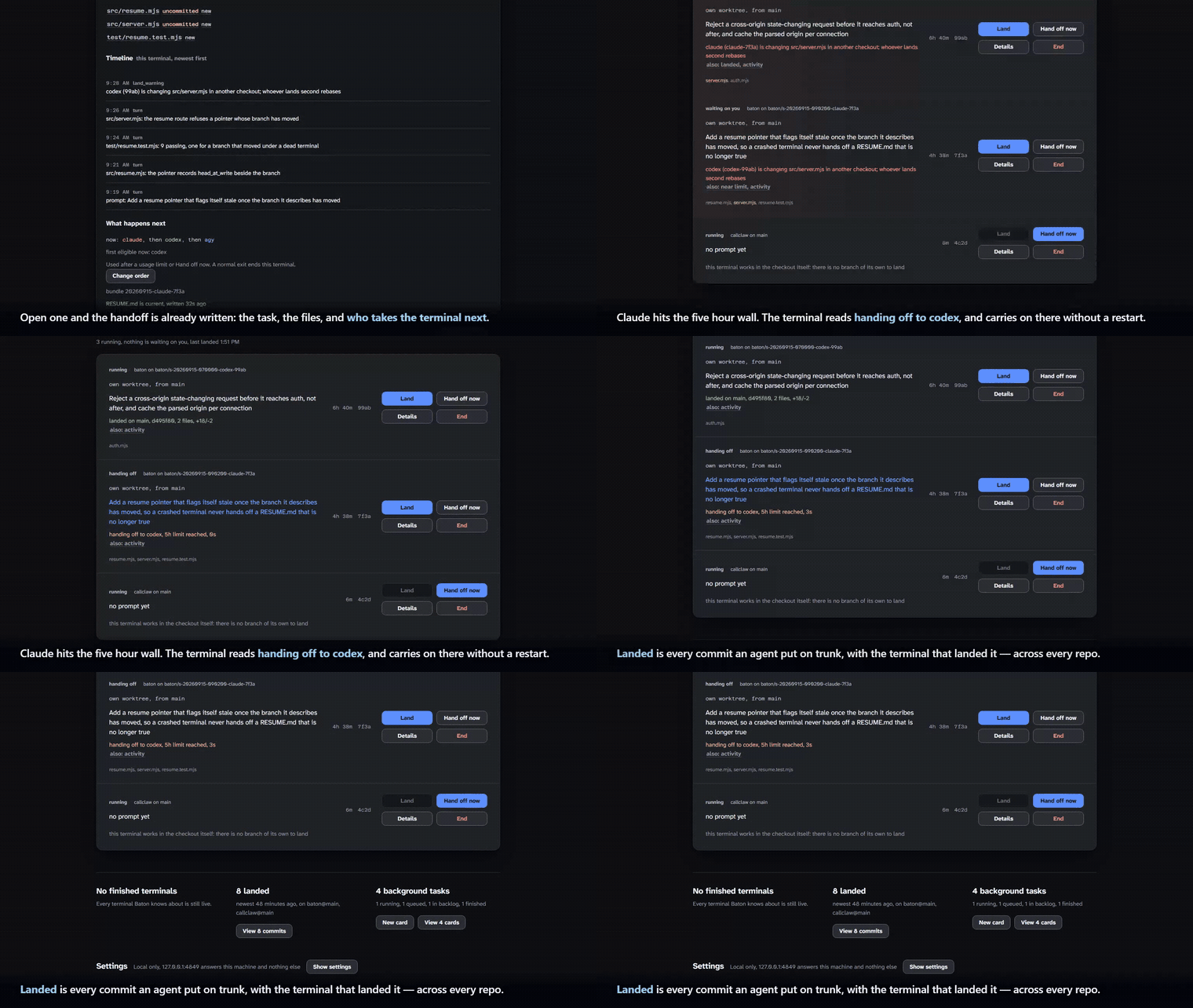
Claude hits the five-hour wall. The terminal reads handing off to codex, and codex carries on there. Nothing is retyped. (the full 53-second run)
You keep using your coding agents exactly as you do today, in any terminal,
from your own config directory: Leg adds its hooks in a separate per-session
settings file and never edits yours. leg claude --model opus is
claude --model opus with four things running alongside it:
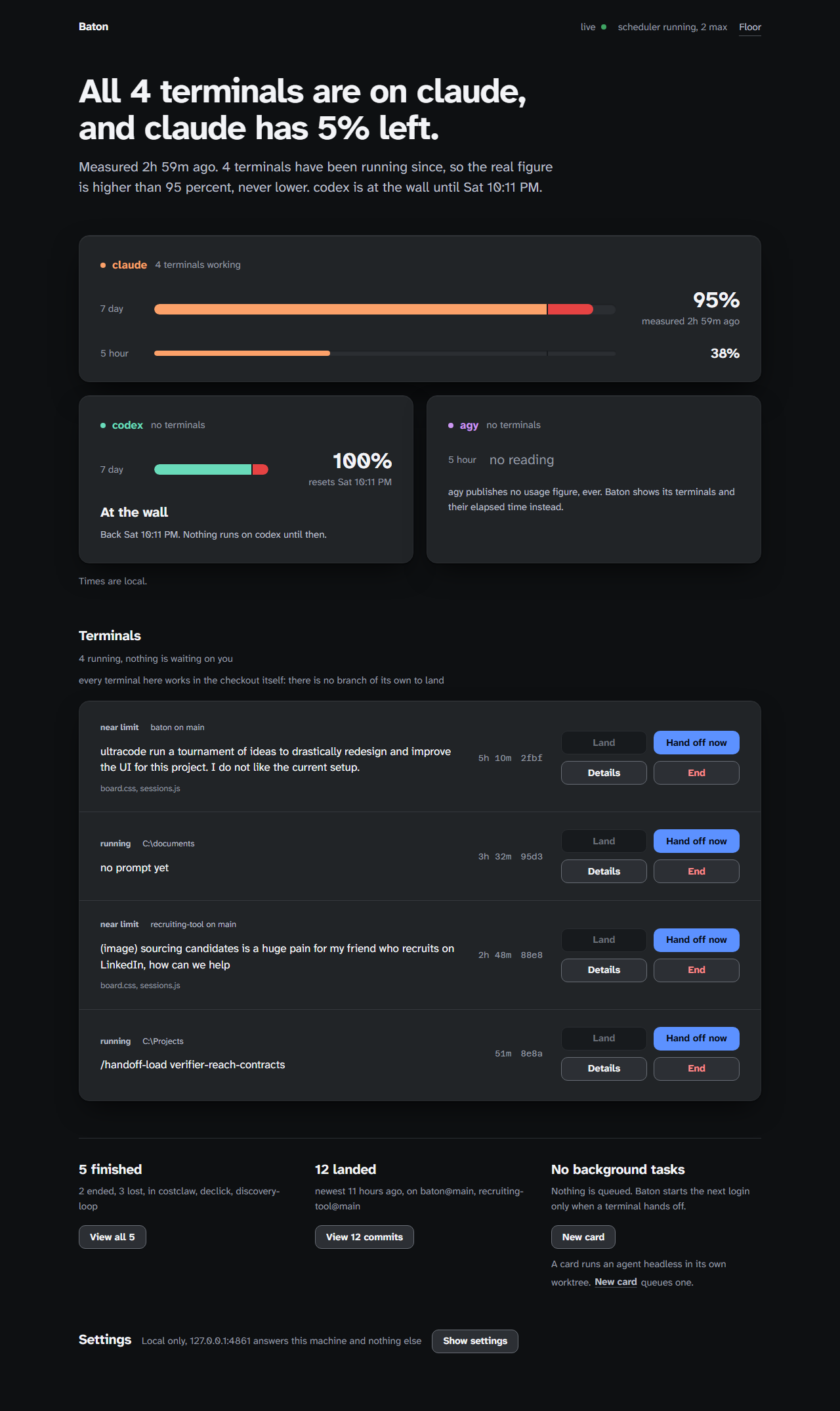
- A board. Opened once in your browser, reused after that. Every Leg session in every terminal is a card on it: agent, account, repo and branch, the task, the files it is touching, its 5h and 7d usage, what has landed on trunk. Two sessions editing the same file in one repo are flagged on both cards, and a second session in a checkout that already has one gets its own worktree and a Land button instead of writing over the first.
- Usage tracking per agent and account, from what each CLI already
exposes: Claude Code's usage endpoint and its
StopFailurehook, Codex's read-only app-server rate-limit read, agy's log. - A context handoff bundle (context-handoff-bundle) refreshed as the session goes, so the work is always ready to hand off.
- The handoff itself. Near the limit you get a warning. At the limit Leg saves the bundle, stops the agent, and starts the next option in the same terminal from that bundle: another login of the same agent if you added one, otherwise the next agent in the order shown on the terminal card. The default is claude → codex → agy, and Settings changes the default for new terminals. Nothing is retyped. When every option is out, it tells you which resets first and when, waits for that reset with a countdown, and starts that agent from the bundle.
Subscription logins only: Leg strips ANTHROPIC_API_KEY,
ANTHROPIC_AUTH_TOKEN, ANTHROPIC_BASE_URL, ANTHROPIC_CUSTOM_HEADERS,
OPENAI_API_KEY, OPENAI_BASE_URL, OPENAI_API_BASE, GEMINI_API_KEY,
GOOGLE_API_KEY, GOOGLE_GEMINI_BASE_URL, GOOGLE_GENAI_USE_VERTEXAI,
GOOGLE_GENAI_USE_ENTERPRISE, GOOGLE_CLOUD_PROJECT,
GOOGLE_CLOUD_LOCATION, GOOGLE_APPLICATION_CREDENTIALS, CLAUDECODE,
CLAUDE_CODE_*, CLAUDE_EFFORT, and CLAUDE_PLUGIN_DATA before any agent
starts. It then sets CLAUDE_CODE_PRINT_BG_WAIT_CEILING_MS=0 for a detached
Claude print session. Leg never edits ~/.claude/settings.json or any other
settings file of yours; its hooks ride in a separate per-session --settings
file. The one thing it does write outside ~/.leg is the folder-trust
answer, below. leg uninstall removes only ~/.leg.
The folder-trust answer
Each agent CLI asks once, the first time it runs in a directory, whether you
trust that folder, and Claude Code asks a second question when a CLAUDE.md
above the repo imports a file from outside it. A handoff fires when the limit
hits, which is usually when nobody is watching, so an agent that stopped on
that prompt would sit there until morning with the bundle already written.
Before starting an agent, Leg records the same answer you would have given,
for the repository you already chose by typing leg claude in it:
| agent | file | what is written |
|---|---|---|
| claude | ~/.claude.json (or $CLAUDE_CONFIG_DIR/.claude.json) |
projects["<repo>"].hasTrustDialogAccepted: true |
| claude | the same entry, only when such an import exists | hasClaudeMdExternalIncludesApproved, hasClaudeMdExternalIncludesWarningShown |
| codex | ~/.codex/config.toml |
[projects."<repo>"] trust_level = "trusted" |
| agy | ~/.gemini/trustedFolders.json |
"<repo>": "TRUST_FOLDER" |
For Claude Code this is the documented remedy: its permissions guide says to
set projects["<path>"].hasTrustDialogAccepted to true in ~/.claude.json,
where <path> is the repository root.
Leg never creates one of those files: if it is not there, that CLI has not
run as you yet and its own first-run flow is next, with you at the keyboard. It
never rewrites a file to say what it already says, and it never removes what is
already in one. When it approves an external CLAUDE.md import it prints the
full path of every file it approved, to the terminal and to the session
timeline on the board, so the approval is on the record rather than invisible.
Set LEG_TRUST=never to switch all of it off and answer the prompts
yourself.
Contents
- 60-second run
- What Leg reads from each agent
- How a handoff works
- Two sessions in one repo
- More than one human
- The board
- Second accounts, and what the terms say
- What is and is not touched
- CLI reference
- Background tasks: the v0.1 extras
- Troubleshooting
- Documentation
- Contributing
- License
60-second run
Prerequisites: Node 22 or newer, git, Python 3 with pip, and at least one
logged-in agent CLI (claude, codex or agy).
npm install -g @ucsandman/legcli
pip install -U context-handoff-bundle
cd <any repo>
leg claude
That is the whole setup. The first leg <agent> starts the board on
http://127.0.0.1:4747 and opens it; later sessions reuse it. Anything after the
agent name passes straight through (leg codex -m gpt-5.3-codex-spark,
leg claude --resume). The agent's own prompt and permission flags pass
through unchanged, and your settings file is never edited: Leg's hooks ride
in a separate per-session --settings file.
The source repository is private. Leg is commercial, source-available
software: every .mjs file that runs is in the package you just installed, at
$(npm root -g)/legcli/src, and the license lets you read it and modify
your own copy. There is nothing compiled, minified or bundled to see through.
What Leg reads from each agent
Nothing is guessed from screen scraping. Each tap was read from the CLI's source or documentation and then checked on a real machine (2026-09-11, Claude Code 2.1.268, codex-cli 0.153.4, agy 1.2.0); the rightmost column says which.
| agent | usage percentages | the wall (limit hit) | how Leg attaches | status |
|---|---|---|---|---|
| claude | GET api.anthropic.com/api/oauth/usage with the login Claude Code stored, the same data as /usage and the built-in status line (five_hour, seven_day, utilization, resets_at); polled every 60 s |
StopFailure hook with error: rate_limit (docs) |
one extra settings file per session via --settings, carrying only Leg's own hooks; autoContinueAtUsageLimit is set to false because Leg owns the handoff |
observed live |
| codex | read-only account/rateLimits/read through the app-server, polled every 60 s by the board and active attach; windows are identified by duration (300 minutes = 5h, 10080 = 7d) |
task_complete.error.codex_error_info: usage_limit_exceeded, message "You've hit your usage limit … try again at …" (codex-rs/protocol/src/error.rs) |
no model turn and no hook are injected; the board reads the CLI backend and records only returned windows | verified by source and regression tests |
| agy | none exposed (agy's own status line fetches a quota summary that is written nowhere) | RESOURCE_EXHAUSTED, "it resets in …", "out of quota" in the log |
--log-file per session; ~/.gemini/antigravity-cli/history.jsonl gives the prompts and conversation id |
observed live (a real RESOURCE_EXHAUSTED with its reset was read from the log on 2026-09-11) |
Why not Claude Code's status line JSON (rate_limits.five_hour.used_percentage):
on 2.1.268 the custom statusLine Leg passes through --settings did not
run, so the endpoint poll is the source. Leg still writes a statusLine
entry that records the same fields, so the moment a build honours it the poll
becomes a fallback.
For Codex, Leg does not infer availability from a lower percentage: only an
explicit available answer from the backend clears an earlier wall. The board
labels each bar as <n>% used and marks an old reading as stale rather than
presenting it as current.
How a handoff works
- Warning. At 85 % of any window (
LEG_WARN_PCT) the session card turns amber, the event log names the next option, and the terminal bell rings once. - Limit. claude: the
StopFailurehook fires withrate_limit. codex: the rollout reportsusage_limit_exceeded. agy: the log saysRESOURCE_EXHAUSTED. The account is marked walled until the reset the CLI reported (or the soonest known window reset). - Bundle. Leg writes structured notes (task, the last messages from the
transcript,
git diff --stat, dirty files, files edited this session, recent commits, why it stopped) and runscontext-handoff-bundle save --repo-localwith one slug per leg; each save writes its own timestamped bundle next to the last one. A checkpoint of the same bundle is taken every two minutes while the session is active. - Switch. The agent process is stopped, the terminal is restored, and the
next option starts in the same terminal with a short pointer prompt:
read
.leg/RESUME-<session-id>.md(thecontext-handoff-bundle loadoutput plus the reason for the switch), checkgit statusandgit diff, continue, do not ask the human to restate the task. The same text is copied to.leg/RESUME.md, the file people open by habit, and both are stamped with the commit and the live terminals they describe.claude "<prompt>",codex "<prompt>"andagy -i "<prompt>"all open the normal interactive session with that first turn. - Order. Other accounts of the same agent come first, then every other agent in the saved order, each tried once. The order is a priority list, not a rotation: put agy at the bottom and agy is the last option from a Claude terminal and from a Codex terminal alike. The board shows the exact sequence with the agent running now skipped, plus the preferred option and the first option eligible from current install and limit state. Use Change order on a terminal card to change that terminal, or Settings to set the default copied by new terminals. An option whose CLI is missing or whose wall has not reset is skipped.
- All out. The terminal prints each option with its reset time, soonest
first, then stays open with a countdown to the first reset and starts that
agent from the bundle when it arrives. The card says
waiting for <agent> at <time>. Ctrl-C (or End on the card) quits with exit 3 instead.
You can force a handoff any time: the Hand off now button on the card, or
leg sessions handoff <id>. Verified on this machine: leg claude opened
the real Claude Code TUI with Leg's hooks firing into the session log, the
usage poll recorded 36 % of the 5h window and 74 % of the 7d window, the
warning fired at 96 % of the 7d window and named codex as the next option, and
a limit saved the bundle, stopped claude and started codex in the same
terminal with the pointer prompt. A real StopFailure arrived on 2026-09-11
and is kept at fixtures/live/claude/limit-rate_limit.json; to drive the path
on demand, leg sessions simulate-limit <id> sends the same StopFailure
rate_limit payload Claude Code would send through Leg's hook: verified end
to end on a haiku session, the hook set the limit, the runner saved the
bundle, stopped claude and started codex, which read .leg/RESUME.md on its
first turn. The simulated wall clears after two minutes and is never kept as
evidence. The first real StopFailure was saved that way, with secrets
scrubbed, at fixtures/live/claude/limit-rate_limit.json, and the claude docs
row flipped to observed-live (node scripts/live-limits.mjs). The same
capture is wired for codex usage_limit_exceeded and agy RESOURCE_EXHAUSTED;
no payload for either has been kept yet.
Terminals started by this version can change order while they run. An older terminal stays on the order it started with; its card says a restart is needed and can save the desired default for the next launch. A normal agent exit ends the terminal. It does not trigger a handoff.
Two sessions in one repo
Two agents in one working tree write over each other's files. So when you
start leg codex in a checkout where leg claude is already live, the new
session gets its own git worktree, <repo>/.leg-worktrees/<session-id> on
branch leg/<session-id>, cut from the branch the checkout has out, and the
terminal prints one line saying where it is. The agent starts there; the card,
the usage tracking and the handoff work the same. --no-worktree shares the
checkout on purpose (Leg takes the flag out; the agent never sees it).
The card of a session with its own worktree has a Land button. It sends
the branch through the merge queue: whatever the agent left uncommitted is
committed on the branch, the branch is rebased onto its base, the repo's test
command runs (package.json test, pytest, or none with a warning), and the
base is fast-forwarded, never merged. When a step fails nothing lands and the
card says why: rebase-conflict with the files, tests-red with the end of
the output, dirty-trunk when the checkout has local changes the landing
would overwrite. Local changes it would not touch are left alone. The
landed-on-trunk list says which terminal landed each commit. Remove safely
prunes a finished session only when its worktree is clean and its branch is
already on the base. Remove record is a separate visible button with a
confirmation: it removes only Leg's saved session record and deliberately
keeps the worktree, branch, unmerged commits, and dirty files.
Verified live on 2026-09-11 with three haiku sessions in a throwaway repo. The
first stayed in the checkout; the second and third each got a worktree and
appended a line to README.md. Land on the second, clicked on the real board,
ran the repo's tests and fast-forwarded main; Land on the third bounced with
rebase-conflict on README.md and kept its commit on its branch; the
landed-on-trunk list named the second terminal (the screenshot above).
More than one human
Off until you run it. leg share on binds the board to your Tailscale
address (or --bind lan, or an address you name) and gives every human their
own name and token; until then the board stays on 127.0.0.1 and there is no
token at all.
leg share on              your own link, printed once
leg share add sam         sam's link, printed once
leg share                 who is on the board (never a token again)
leg share rotate sam      sam's old link stops working
leg share off             back to 127.0.0.1; every link stops working
A token is kept as a sha256 hash, so a lost link is re-issued, never re-read. The board takes the token out of the address bar and keeps it in the browser. Your own browser on this machine needs no token.
What another human sees is the Terminals region, read-only. Each panel says
whose terminal it is. On a panel that is not theirs there is no prompt, no file
name, no path, no bundle and no event log; what stays is the agent and session
tail, the status word, the sentence read-only: wes owns this terminal,
repo@branch, the worktree line, the elapsed clock, and one button,
Request handoff. The instrument head prints not shared in place of every
percentage. A request lands on the owner's panel as sam asked to take this terminal at 11:04 PM with Approve sam and Dismiss sam. The background
side of the board (cards, logs, the floor) stays the owner's alone. A terminal
belongs to the human who started it: LEG_PERSON=sam leg claude on the
same machine is sam's card, not yours.
The security pass that goes with it: every /api route needs a token, the
event stream included; twenty wrong tokens from one address and that address
waits a minute; one identity gets 600 requests a minute; a guest gets 403 on
everything that is not theirs; and the tests send a bad and a missing token to
every route. There is still no TLS, so keep this on Tailscale or a network you
trust. Verified live on 2026-09-11: two terminals on one machine, one wes's and
one sam's; sam's board showed wes's card with the prompt hidden and only
Request handoff, and sam's request reached wes's board (~/.leg/board.log:
"hand-off requested … by sam").
The board
leg <agent> opens it; leg open reopens it; leg down stops it.
- Instrument head: one row per login, sticky at the top of the board and of
the floor. Each row carries the 5h and 7d rails, the percentage, when that
window resets and how long that is, a burn-rate sentence under the 5h rail,
where and when Leg read the number, and one word for the state:
under 60,over 60,over 85,stale <n>m,at the wallorno reading. A login at its wall keeps both rails and gainsat the wall,back <day time>andin <duration>beside them. - Terminals: one full-width panel per session, the ones that need an answer
first. Agent and session tail, the status word, the first prompt as a button,
exactly one sentence (the highest-ranked thing true about the terminal), an
also:disclosure naming the rest, the files as comma-separated text,repo@branch,own worktree, from mainwhen the session cut its own worktree, and an elapsed clock. Two live sessions in one repo touching the same file printcodex (codex-99ab) is changing src/server.mjs in another checkout; whoever lands second rebaseson both panels, and a panel that needs you rises one step and sayswaiting on youin place of its status word. After a Land the sentence islanded on <base>, <7-char sha>, <n> files, +<added>/-<removed>, orLand was attempted at <time> onto <base> and bounced: <first line of the reason>. The branch still holds every commit; nothing was lost. - Landed on main: one flat list across every repo the board can see, newest
first, each row with the short sha, the subject, a
repo@branchchip, and when plus who. A commit a Land put there sayslanded by <agent> (<id tail>). - Buttons, in a fixed order that never reflows: Land, Hand off now, Details, End. Once a session has ended, Remove and Remove record take End's place. Details opens an expansion in flow under the panel.
- Below it, optional Background tasks an agent runs in a separate worktree without joining the terminal conversation (see below), then Settings.
The board reads ~/.leg/sessions/*/session.json over server-sent events; a
session whose runner process is gone is marked lost, never shown as live.
Second accounts, and what the terms say
Optional. leg accounts add claude work creates
~/.leg/accounts/claude/work, junctions your hooks, skills, agents,
commands, plugins, rules, scripts, output-styles and tools into it,
copies settings.json, CLAUDE.md and the status-line scripts (refreshed from
your real ~/.claude before every launch), and prints one line to paste:
$env:CLAUDE_CONFIG_DIR='C:\Users\you\.leg\accounts\claude\work'; claude auth login
Same for codex (CODEX_HOME; config.toml, AGENTS.md, skills, prompts,
rules, plugins, agents, hooks, memories shared). agy 1.2.0 has no
config-directory override, so it stays one account. Only the login lives in
the account directory; leg accounts rm removes the junctions and the
directory and never touches your real home.
The terms, as published (effective dates below):
- Anthropic Consumer Terms (effective 2025-10-08): "You may not share your Account login information, Anthropic API key, or Account credentials with anyone else" and you "must not … bypass any of our systems or protective measures."
- Anthropic Usage Policy (effective 2025-09-15): do not "Coordinate malicious activity across multiple accounts to avoid detection or circumvent product guardrails" or "Utilize automation in account creation."
- OpenAI Terms of Use (effective 2026-01-01): "You may not share your account credentials or make your account available to anyone else" and you may not "circumvent any rate limits or restrictions or bypass any protective measures."
Owning two paid subscriptions is not named as prohibited by either. Rotating to
a second account of the same vendor because the first one is rate-limited sits
close to OpenAI's "circumvent any rate limits" wording and Anthropic's
"circumvent product guardrails". Leg's default chain switches vendors
(claude → codex → agy), which is plainly fine. Same-vendor rotation only
happens after you run leg accounts add; that is your call.
What is and is not touched
- Never edited:
~/.claude/settings.json,~/.claude.json,~/.codex/config.toml, agy's files, your repo's settings. Claude Code gets hooks through a per-session--settingsfile under~/.leg; codex and agy get nothing injected. - Written in your repo:
.leg/(session notes,RESUME.mdand oneRESUME-<session-id>.mdper hand-off),.context-handoffs/(the bundles) and.leg-worktrees/(a second session's worktree), all added to.git/info/exclude, plus theleg/<session-id>branch of a session with its own worktree. Landing fast-forwards your branch; nothing is ever pushed. - Stripped from every agent's environment:
ANTHROPIC_API_KEY,ANTHROPIC_AUTH_TOKEN,ANTHROPIC_BASE_URL,ANTHROPIC_CUSTOM_HEADERS,OPENAI_API_KEY,OPENAI_BASE_URL,OPENAI_API_BASE,GEMINI_API_KEY,GOOGLE_API_KEY,GOOGLE_GEMINI_BASE_URL,GOOGLE_GENAI_USE_VERTEXAI,GOOGLE_GENAI_USE_ENTERPRISE,GOOGLE_CLOUD_PROJECT,GOOGLE_CLOUD_LOCATION,GOOGLE_APPLICATION_CREDENTIALS,CLAUDECODE,CLAUDE_CODE_*,CLAUDE_EFFORT, andCLAUDE_PLUGIN_DATA.CLAUDE_CODE_*does not includeCLAUDE_CODE_PRINT_BG_WAIT_CEILING_MS: Leg sets that one to0for a detached Claude print session. - Read but never written or printed: Claude Code's stored login, sent only
to
api.anthropic.comfor the usage numbers. The ledger scrubs bearer tokens and key shapes from every line regardless. leg uninstall --yes: removes~/.leg(sessions, usage, extra account directories with their junctions, v0.1 cards, the board pidfile) and nothing else; thennpm rm -g legcli.
CLI reference
leg claude|codex|agy [agent args…]   the interactive agent, board alongside, handoff on limit
      [--no-worktree]                  share the checkout with a live session instead of a worktree
leg sessions ls [--json]             every session and its usage
leg sessions show|events <id>
leg sessions handoff|end <id>        same as the board buttons
leg sessions rm <id>                 forget an ended session
leg sessions simulate-limit <id>     the real limit path without a real wall (claude, agy)
leg accounts ls                      logins and their 5h/7d usage
leg accounts add <claude|codex> <name> | rm <agent> <name> | terms
leg license                          the license on this machine, or where to buy one
leg license activate <key> | deactivate | refresh   (refresh renews a Team key)
leg share                            who is on the board (off by default; Team plan)
leg share on [--bind tailscale|lan|<addr>] [--port N] | off
leg share add|rotate|rm <name>       one link per human, printed once
leg open | down | status             the board
leg uninstall [--yes]
Environment, all optional: LEG_HOME (default ~/.leg), LEG_PORT
(4747), LEG_ACCOUNT (start on a named login), LEG_WARN_PCT (85),
LEG_NO_HANDOFF=1 (warn and record, never switch), LEG_NO_OPEN=1 (do not
open the browser), LEG_USAGE_POLL_MS (60000), LEG_CLAUDE_ARGS /
LEG_CODEX_ARGS / LEG_AGY_ARGS (extra args for a leg Leg starts after
a hand-off, e.g. -m gpt-5.3-codex-spark), LEG_CLAUDE_BIN,
LEG_CODEX_BIN, LEG_AGY_BIN, LEG_CHB_BIN, LEG_PERSON (whose
terminal this is when the board is shared), LEG_RATE_MAX (600 requests a
minute per human) and LEG_RATE_MAX_FAILURES (20 wrong tokens per address).
Background tasks: the v0.1 extras
Version 0.1 was the other way round: you dropped a task card on the board and Leg ran the agents headless in a git worktree, one per card, with a fallback chain, path leases, a scheduler and a merge queue. All of that still works and lives below the terminals lane, but it is no longer the way in.
The New background card form starts with a repo, task, and real first agent. Run now queues it; turning that off saves a draft in Backlog. The default Build only workflow stops with its changes in the card's worktree and does not merge them. The Advanced Build, test, and merge and Factory workflows include an automatic land station; their labels say so before you choose them. Fallback agents, permissions, approval gates, turn caps, leases, trunk, merge method, tests, title, and scripted test/demo adapters are also under Advanced options.
leg upboots the board with the scheduler and merge queue and streams redacted logs;leg card add --repo <path> --task "<t>" --chain claude,codex --queuecreates a card; presetsbuild,build-land,factory; station kinds agent, test, land, human.- Adapters spawn the CLIs headless as argv, never through a shell, with their
own permission modes and never a bypass flag:
claude -p --output-format json --permission-mode <m>,codex exec --json -s <m> -C <worktree>,agy -p --output-format json --mode <m> --add-dir <worktree>;fake,fake-claude,fake-codex,fake-agyfor tests and demos. - A leg that ends on a limit signal, a stall, a crash or exit 0 without
.leg/DONEhands off with a bundle to the next adapter in the same worktree; alandstation rebases, tests and fast-forwards trunk or bounces the card with the failure in the bundle. - Optional mirrors, off unless set in
.env: OpenClaw Workboard (LEG_SYNC_WORKBOARD=1) and DashClaw (LEG_SYNC_DASHCLAW=1).
The full v0.1 story, with the fake-limit demo and the real claude→codex run, is in docs/concepts.md, docs/DEMO.md, docs/real-run.md and docs/board-guide.md.
Network exposure
Leg binds 127.0.0.1. leg share on is the supported way to listen
anywhere else: it binds your Tailscale or LAN address and every human gets
their own token (see More than one human). Without
share, setting LEG_BIND to a non-loopback address needs LEG_TOKEN too,
or the server refuses to start (exit 3), and requests then need
Authorization: Bearer <token>. Tokenless owner access also requires a
loopback hostname (127.0.0.1, localhost, or [::1]), which prevents a
DNS-rebound hostname from inheriting local access. Either way there is no TLS.
Troubleshooting
- The board did not open:
leg open, or visit http://127.0.0.1:4747.~/.leg/board.loghas the server's output. - claude's card shows "usage unknown": Claude Code has no stored claude.ai
login in that config directory (run
claude auth login), the stored token expired (startclaudeonce, it refreshes), or the usage endpoint answered with something Leg does not recognise. The card says which. The wall is still caught through the hook; only the percentages are missing. - codex usage is unavailable or stale: the read-only Codex app-server quota request failed or has not completed in the last five minutes. The board retries every minute; an active Codex session also keeps its rollout tap as a fallback for percentages and the wall signal.
- agy's card has no percentage: expected, agy exposes none. Leg sees the wall when agy hits it.
- A session shows
lost: the terminal that ranleg <agent>is gone (closed, crashed, machine slept through a kill). Remove it from the board. - Nested session:
leg claudetyped inside a Claude Code shell works; the parent'sCLAUDECODEmarkers are stripped so the child starts. npm installdies withedgesOut(clone only): the global npm is older than Node; runnpx --yes npm@latest installonce.
More in docs/faq.md.
Documentation
| guide | read it when |
|---|---|
| Getting started | you want leg claude running in five minutes |
| Concepts | sessions, accounts, bundles, and the v0.1 cards, stations, chains and leases |
| Board guide | every word, number and button on the board explained |
| Configuration | environment variables and options |
| Adapters | what each CLI exposes and how Leg attaches to it |
| CLI contracts | exact argv per CLI and the limit-signal table with sources |
| FAQ | a question the others did not answer |
| Demo and real run | the v0.1 handoff, fake and real |
| Vocabulary | statuses, outcomes and event types |
| Roadmap v2 | where this is going |
| Reuse and deviations | what was ported and every place the plan changed |
| Website | the public page: static HTML in site/, preview with python -m http.server 4780 --directory site, deployed to Vercel from that directory; PRODUCT.md and DESIGN.md at the root carry its brief and tokens |
Contributing
Issues and pull requests are welcome. Read CONTRIBUTING.md for the dev setup and the rules (zero runtime deps, argv spawns only, no bypass flags, a privacy check on every commit). Security reports go through SECURITY.md.
npm install
npm test          # node --test + privacy check
npm run lint
Any real agent session started only to test Leg runs on the cheapest model
(leg claude --model haiku); the live checks in test/ never start one.
Maintainer releases use npm trusted publishing with no NPM_TOKEN. Bump the
package, lockfile, site metadata and release notes, then push main. CI waits
for the Ubuntu and Windows test matrix, validates the exact version against
npm, and publishes only when that version is missing and newer than the stable
latest. Existing versions skip cleanly; older, prerelease, and registry-error
cases fail the job. The npm trusted publisher is bound to
ucsandman/legcli and .github/workflows/ci.yml. The repository stays private,
so publication uses --provenance=false.
Privacy and attribution
Parts of the runner, ledger and git snapshot were ported from a private
repository that was MIT licensed (see NOTICE and
docs/REUSE.md), with chat identifiers, machine paths and
personal names removed. The test suite runs a privacy check on every commit,
and the fixtures store home paths as ~.
License and pricing
Leg is commercial software under the Leg License Agreement. It ships as readable JavaScript so you can see what it does on your machine, and you may modify it for your own use, but not redistribute it or work around the license check. Versions 0.2.0 and 0.3.0 were published under MIT and remain available. The version in this source tree is 0.7.0; see npm for published versions and CHANGELOG.md for release notes.
Using it needs a license: Personal, $79 once, one human on any number of
machines, every release for 12 months and the version you have keeps working
after that; Team, $12 per seat per month, Personal plus leg share for
more than one human on the board. Buy at the site, then
leg license activate <key>. There is no trial; there is a 30-day
money-back guarantee, so the way to evaluate Leg is to use it on real work
and ask for a refund if it does not earn its place. A key is a signed token
checked offline with the public key in src/license.mjs; only a Team key
renewal talks to the site. The bare agent CLIs are never affected by any of
this; only what Leg adds is licensed.
Leg is commercial, source-available software by Wes Sander. The source you run ships in the npm package. Questions or a refund: legcli@practicalsystems.io.